
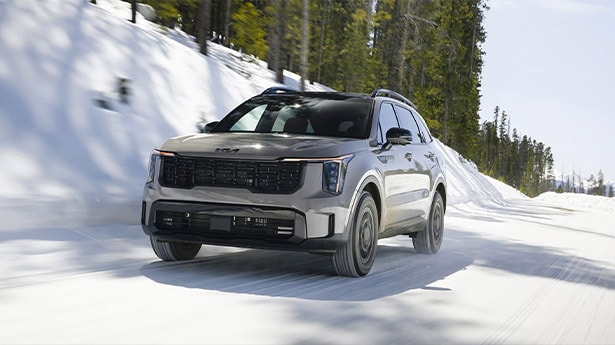
Northeast Ohio winters bring unpredictable road conditions, shifting rapidly from wet slush to deep snow and black ice. For drivers navigating the daily commute along Interstate 271 or traveling through Bedford, having a vehicle equipped with a reliable all-wheel-drive system is essential for maintaining control and stability. Kia has engineered a diverse lineup of vehicles featuring highly advanced all-wheel-drive systems, designed to deliver optimal traction when the weather takes a turn for the worse.
Rather than relying on older, reactive systems that only respond after your tires begin to spin, modern Kia models utilize active, intelligent technology to continuously monitor the road and distribute power where it is needed most. Whether you are driving a compact crossover, a three-row family SUV, or an all-electric vehicle, the engineering behind Kia AWD is built to handle the unique challenges of local winter driving.
If you are ready to experience this stability firsthand, you can schedule your test drive online to feel how these systems perform on the road. For personalized assistance or to ask about model availability, feel free to give our team a quick call at (440) 659-2032. When you are ready to visit our showroom, you can easily get directions to our dealership located at 18180 Rockside Rd, Bedford, OH 44146.
How Kia Dynamax All-Wheel Drive Predicts Road Grip Before Wheels Slip
To understand why Kia vehicles perform so well in winter weather, it helps to look at how Dynamax All-Wheel Drive operates compared to traditional reactive systems. Traditional, older AWD systems typically operate in front-wheel drive until a wheel actually loses grip. Only after the slip occurs does a mechanical coupling engage to send power to the rear axle. In contrast, the Dynamax systemâÂÂdeveloped in partnership with Magna PowertrainâÂÂis a fully active, continuous AWD system.
By utilizing an intelligent control unit that constantly exchanges data with the vehicle's electronics, Dynamax continuously monitors driving conditions. It analyzes variables such as steering angle, speed, throttle position, and lateral acceleration. The system then uses an electro-hydraulic actuation system and a multi-plate clutch to proactively distribute torque to the front and rear axles before slippage can even begin.
This proactive power distribution provides several distinct advantages for local drivers:
- Improved Lateral Stability: By optimizing torque distribution through the driveline, the system reduces the risk of unintended oversteer or understeer, helping you maintain your intended path through slick corners.
- High Thermal Capacity: The electro-hydraulic coupling features a high thermal capacity, which prevents the system from overheating and shutting down during prolonged, heavy-duty use in deep snow or mud.
- Enhanced Efficiency: When cruising at steady highway speeds on dry pavement, the system directs the majority of the power to the front wheels to minimize parasitic drag and maximize fuel economy.
Choosing the Best 2026 Kia Sportage AWD Configuration for Your Commute
For drivers seeking a highly versatile compact SUV, the 2026 Kia Sportage offers multiple all-wheel-drive configurations tailored to different driving preferences and efficiency goals. The gas-powered lineup features a 2.5L 4-cylinder engine producing 187 hp and 178 lb-ft of torque, paired with an 8-speed automatic transmission. In this lineup, AWD is available as an option on several trims and comes standard on the rugged X-Line, X-Pro Prestige, and SX Prestige models [1].
If fuel economy is your primary focus for a long daily commute, the EX Hybrid AWD trim is an exceptional alternative. The hybrid powertrain pairs standard all-wheel drive with a highly efficient engine, delivering an EPA-rated 38 mpg city / 38 mpg highway [1]. This stands in stark contrast to the gas-powered EX AWD model, which is EPA-rated at 23 mpg city / 26 mpg highway [5].
Both the gas and hybrid AWD versions of the Sportage benefit from highly capable winter features. The EX Hybrid AWD trim provides 8.3 inches of ground clearance, matching the gas AWD models to help you clear unplowed neighborhood streets [1]. Additionally, the Sportage features a dedicated Terrain Mode with specific Snow, Mud, and Sand settings to optimize power delivery and traction in deep winter conditions [1]. The hybrid models also include a center-locking differential, allowing you to manually lock a 50/50 power split between the front and rear axles for maximum low-speed traction on icy surfaces [1].
Towing Capacities and Ground Clearance of Kia AWD SUVs for Winter Hauling
When winter weather requires hauling trailers, winter sports gear, or small recreational vehicles, knowing your SUV's towing capacity and physical capability is crucial. Kia's AWD SUV lineup provides a range of options depending on how much utility and space your lifestyle demands.
The three-row 2026 Kia Sorento is a highly popular midsize option, offering seating for 7 passengers and a starting MSRP of $38,490 for the EX trim. When equipped with the robust 2.5L turbocharged engine and 8-speed dual-clutch transmission, the Sorento AWD delivers 281 hp and 311 lb-ft of torque, enabling a maximum towing capacity of 3,500 lbs. For larger hauling needs, the 2026 Kia Telluride AWD provides standard Terrain Mode with a dedicated Snow Mode and a maximum towing capacity of up to 5,500 lbs when properly equipped.
If you prefer a more compact footprint, the 2026 Kia Sportage AWD models provide a respectable towing capacity of 2,500 lbs (or up to 1,653 lbs for the X-Pro trim without an auxiliary brake controller). Ground clearance also plays a vital role in winter capability. While the Sportage AWD offers 8.3 inches of ground clearance [1], the Telluride X-Pro trims elevate that capability with 9.1 inches of ground clearance and standard 18-inch all-terrain tires to handle deep snow drifts.
Electric Performance in the Cold: The Kia EV6 AWD Heat Pump Advantage
Electric vehicle shoppers often wonder how battery-powered models perform when temperatures drop. In Northeast Ohio, prolonged winter cold can impact an EV's driving range. To address this, AWD versions of the 2026 Kia EV6âÂÂincluding the Light Long Range AWD, Wind AWD, and GT-LineâÂÂcan be equipped with an energy-efficient, range-preserving heat pump system.
Traditional electric vehicle cabins are warmed using resistive heaters, which draw directly from the high-voltage battery and can significantly reduce range. The EV6's heat pump system works by capturing waste heat from the vehicle's electric motors and power electronics, recycling that thermal energy to warm the passenger cabin. This clever engineering helps mitigate typical cold-weather range loss, which generally spans a band of 15% to 30% on the coldest days.
The 2026 Kia EV6 dual-motor e-AWD system delivers an impressive 320 hp and 446 lb-ft of torque, launching the vehicle from 0-60 mph in just 5.0 seconds. The Wind AWD trim features an 84.0 kWh battery pack, offering an EPA-estimated all-electric range of 295 miles on a full charge. When it is time to charge, the EV6's advanced 800V architecture allows the battery to go from 10% to 80% in approximately 18 minutes when using a 350 kW DC fast charger.
Answers to Common Questions About Kia AWD Performance and Winter Settings
Before driving home in a new AWD vehicle, buyers often have questions about how to maximize their vehicle's safety features and how to handle routine winter adjustments.
How does Kia Electronic Stability Control assist on icy patches?
A: Electronic Stability Control (ESC) is designed to stabilize the vehicle during sudden cornering maneuvers or when driving on slick surfaces. The system continuously monitors your steering input and compares it to the vehicle's actual direction. If ESC detects a discrepancy or a loss of traction, it automatically applies the brakes to individual wheels and reduces engine power to help you regain control. When the system is actively working, you will see the ESC indicator light blink on your dashboard, and you may feel a slight pulsation in the brake pedal, which is completely normal.
What is the recommended tire pressure for a Sorento AWD in winter?
A: For the Kia Sorento, the recommended cold tire pressure is typically 34 PSI, though this can vary slightly depending on your specific wheel and tire package. Because outdoor temperatures directly affect tire pressureâÂÂdropping about 1 to 2 PSI for every 10-degree drop in temperatureâÂÂit is common for the low tire pressure warning light to illuminate on cold mornings. Always check your tire pressure when the tires are "cold" (idle for at least three hours) and refer to the tire placard located on the driver's side doorjamb for the exact recommended PSI.
Do I need to manually activate the AWD system in my Kia SUV?
A: No, Kia's Dynamax AWD and dual-motor e-AWD systems operate fully automatically. The onboard computer continuously monitors traction and distributes torque to the wheels with the most grip without requiring any driver intervention. However, if you are navigating particularly deep snow or mud at low speeds, you can press the center-lock button (available on models like the Sportage and Sorento) to lock the front and rear axles into a 50/50 power split for enhanced stability.
Categories:
News