
Northeastern Ohio winter weather brings unpredictable road conditions, making advanced driver-assist technology a primary consideration for local car buyers. Navigating the Interstate 271 corridor during a lake-effect snowstorm requires heightened driver focus and responsive vehicle systems. The active safety suite developed by Kia is designed to monitor road conditions and surrounding traffic, providing real-world reassurance during daily commutes.
When local drivers visit our showroom to explore the latest models, they frequently ask how active safety systems handle sudden stops on slick highways. The technology acts as an extra set of eyes, utilizing a network of sensors and cameras to monitor traffic flow. For families traveling past the Bedford Reservation of the Cleveland Metroparks, these systems offer continuous monitoring to help mitigate potential hazards before they escalate.
Selecting a vehicle with robust driver-assistance systems provides long-term confidence on both fast-moving highways and busy suburban streets. Our team is ready to demonstrate these features during a personalized vehicle walk-around. To experience how these active safety systems perform on local roads, you can schedule your test drive online. If you prefer to speak with a representative directly, feel free to give our sales team a quick call, or get step-by-step directions to plan your visit and view our physical showroom at 18180 Rockside Rd, Bedford, OH 44146.
What Is Kia Drive Wise and How Does the System Protect You?
The proprietary driver-assistance suite, known as Kia Drive Wise, integrates radar, camera, and ultrasonic technologies to provide additional driver assistance around the vehicle. By constantly scanning the road ahead, monitoring blind spots, and tracking lane markings, the system processes real-time data to assist with steering, braking, and acceleration. Rather than operating as a single component, it functions as a cohesive network of individual safety systems designed to prevent collisions.
The system operates through three progressive stages of driver support:
- Visual and Audible Alerts: The vehicle identifies potential hazards, such as a slowing car ahead, and alerts the driver via instrument cluster graphics and warning chimes.
- Haptic Feedback: On select models, the steering wheel vibrates to gently nudge the driver's attention back to the road if a lane drift is detected.
- Active Intervention: If the driver does not react to the warning signals, the system can autonomously apply braking pressure or steering corrections to help avoid an impact.
This advanced technology is integrated across our entire lineup of new SUVs and sedans. If you are shopping for a highly capable vehicle equipped with these features, you can browse our current new-vehicle inventory to compare different body styles. Before stopping by, you can also view our new vehicle specials to see current promotional offers, or use our digital trade-in tool to value your trade-in and receive an instant cash offer for your current car.
âÂÂÂÂÂÂÂÂ
Which Safety Features Are Standard in the Kia Drive Wise Suite?
A major advantage of choosing a modern Kia is the generous level of standard safety equipment included on entry-level models. Buyers do not have to purchase top-tier luxury trims to secure essential driver-assist technologies. For example, the entry-level LX trim of the 2026 Kia Sportage includes a robust selection of active safety features as standard equipment, demonstrating our commitment to occupant protection.
The standard safety package typically includes several core technologies designed for daily driving:
- Forward Collision-Avoidance Assist: Uses a front camera and bumper-mounted radar to detect vehicles, pedestrians, or cyclists ahead, applying emergency braking if a collision is imminent.
- Lane Keeping Assist: Monitors lane markings and applies subtle steering inputs to keep the vehicle centered if it begins to drift without a turn signal.
- Lane Following Assist: Tracks the vehicle ahead and lane markings to help position the car precisely in its lane when cruise control is active.
- Driver Attention Warning: Analyzes driving patterns and alerts the driver with a warning chime if it detects signs of fatigue or inattentive behavior.
- Rear Occupant Alert: Reminds the driver to check the back seats before exiting the vehicle, helping to protect children or pets.
These standard systems provide a strong foundation of safety for every journey. To see how these features are packaged across different models, you can explore our virtual showroom to view detailed trim comparisons. Once you find the right model for your lifestyle, you can explore financing options online to find a payment structure that fits your budget.
âÂÂÂÂÂÂÂÂ
Does Kia Drive Wise Require a Paid Monthly Subscription?
A common concern among car shoppers is whether advanced safety features are hidden behind a recurring paywall. Fortunately, Kia Drive Wise active safety and driver-assist technologies are built-in hardware capabilities that do not require any monthly or annual subscription fees. Once you purchase or lease the vehicle, features like Forward Collision-Avoidance Assist and Blind-Spot Collision-Avoidance Assist remain fully active and functional for the lifetime of the vehicle.
While the active safety systems do not require a subscription, certain remote connectivity features, such as remote climate preconditioning or remote lock/unlock, are managed through the Kia Connect app, which may offer trial periods followed by optional paid tiers. However, the core safety, braking, and steering assist systems operate independently of any cellular connection or subscription plan. This means second and third owners of pre-owned models enjoy the exact same safety protections without paying extra.
This subscription-free safety model makes our pre-owned inventory an exceptional value for budget-conscious buyers. If you are looking for a reliable, tech-forward vehicle, you can browse our used vehicle inventory to find high-quality models equipped with advanced safety suites. If you have questions about the specific safety features equipped on a particular model, please contact us today to speak with a sales consultant.
âÂÂÂÂÂÂÂÂ
Comparing Blind-Spot Collision-Avoidance Assist and Blind-Spot View Monitor
While both systems are engineered to prevent side-impact collisions, they utilize different technologies to protect your vehicle. The foundational system is Blind-Spot Collision-Avoidance Assist. This feature uses radar sensors located in the rear bumper to monitor your rear quarter panels. If you activate your turn signal to change lanes while a vehicle is detected in your blind spot, the system flashes a warning icon in the side-view mirror, sounds an alert, and can apply gentle braking pressure on the opposite wheel to guide you back into your lane.
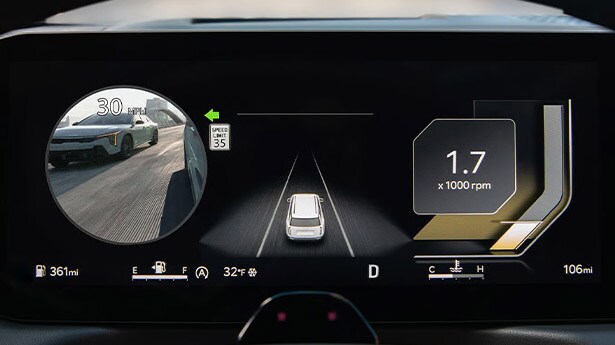
In contrast, the Blind-Spot View Monitor is a visual convenience feature that acts as an extension of your instrument cluster. When you activate your turn signal, high-definition, wide-angle cameras mounted under the side mirrors project a live video feed of your blind spot directly onto the digital gauge display. This visual aid is especially useful when navigating tight parking garages or changing lanes in heavy rain, giving you a clear view of low-profile hazards like motorcycles or small sports cars.
On premium trims, such as the GT-Line of the 2026 Kia EV9, these two technologies work in tandem to provide both visual confirmation and active physical intervention. To help streamline your shopping experience, you can get pre-qualified for financing online using our secure portal. For more detailed breakdowns of specific vehicle technologies and model comparisons, you can also read our latest blog posts written by our local automotive experts.
âÂÂÂÂÂÂÂÂ
How Highway Driving Assist and Speed Limit Adjustment Work
For drivers who spend significant time on the highway, Highway Driving Assist offers a sophisticated level of driving support by combining Smart Cruise Control with Lane Following Assist. When driving on designated federal or state highways, this system automatically controls steering, acceleration, and braking to maintain a safe following distance from the vehicle ahead while keeping your car perfectly centered in its lane.
The system integrates directly with your vehicle's navigation system and front-facing cameras to enable Navigation-based Smart Cruise Control. This allows the vehicle to adjust its speed dynamically based on real-world road geometry and posted speed limits:
- Curve Speed Control: The system uses navigation data to anticipate upcoming curves on the highway, proactively reducing your speed to ensure a smooth, comfortable ride before accelerating back to your set speed.
- Highway Auto Curve: On select highway interchanges, the vehicle automatically adjusts its speed to match the curvature of the ramp.
- Intelligent Speed Limit Assist: The front-facing camera scans speed limit signs along the road, prompting the driver to adjust the cruise control speed, or automatically adjusting it to match the new legal limit when configured.
On newer models, the upgraded Highway Driving Assist 2 system adds an automatic lane-changing function. When you activate your turn signal on the highway, the system scans for an open gap in the adjacent lane and safely steers the vehicle over automatically. To experience this high-tech driving assistant in person, you can get directions to our dealership and plan a visit. If you are ready to begin the buying process, you can apply for financing now to secure your pre-approval before your showroom visit.
âÂÂÂÂÂÂÂÂ
Common Questions About Managing Kia Drive Wise Safety Alerts
Drivers occasionally ask if they can customize how their safety systems behave. Yes, the active safety suite is highly customizable through the vehicle's central touchscreen menu. Under the vehicle settings, you can adjust the warning volume, choose between early or late alert timing, or switch a feature from active intervention to warning-only mode. For example, if you find the steering wheel vibrations of Lane Keeping Assist too intrusive during local driving in Bedford Heights, you can easily toggle the system to provide simple audible alerts instead.
While the system allows you to temporarily disable certain features, like parking distance warnings, the core safety systems are designed to reset to their default active settings every time you start the vehicle. This safety protocol ensures that critical systems like Forward Collision-Avoidance Assist are always ready to protect you on your next journey. Our delivery specialists are happy to walk you through these menus and customize your settings before you drive your new vehicle off the lot.
If you want to explore these customizable menus in person, stop by our showroom to learn more about us and our commitment to customer satisfaction. For immediate assistance with any vehicle questions or to check current showroom hours, you can reach our sales desk by giving us a quick call.
Quick Answers Before You Visit
Q: Does the Forward Collision-Avoidance Assist system detect pedestrians in the dark?
A: Yes, the system uses a combination of a high-resolution front windshield camera and radar sensors in the front bumper to scan the road ahead. The radar detects physical objects in low-light conditions, while the camera identifies the specific shapes of pedestrians and cyclists, allowing the system to calculate collision risks even during night driving.
Q: Can heavy snow or road salt affect the Drive Wise sensors?
A: Yes, heavy accumulation of snow, ice, or road salt on the front bumper or windshield can temporarily block the radar sensors and cameras. If this occurs, the vehicle will display a temporary warning message in the instrument cluster indicating that a specific system is blocked, and the features will automatically resume normal operation once the sensors are cleared.
Q: Is Highway Driving Assist considered a fully autonomous driving system?
A: No, Highway Driving Assist is classified as a Level 2 semi-autonomous driving system. It requires the driver to keep their hands on the steering wheel and remain fully attentive at all times, utilizing built-in steering wheel sensors to ensure the driver is actively engaged in operating the vehicle.
Q: What is the difference between Lane Keeping Assist and Lane Following Assist?
A: Lane Keeping Assist is a reactive system that only intervenes with steering corrections if your vehicle begins to drift over a lane marking without a turn signal. Lane Following Assist is an active, continuous system that works with cruise control to keep the vehicle constantly centered between the lane lines.
Prices and MSRP referenced in this article are estimates for informational purposes only and do not constitute an offer to sell. See dealer for complete details. Fuel economy estimates shown may differ from official EPA ratings and should not be relied upon as a guarantee of actual vehicle performance.
Prices and MSRP referenced in this article are estimates for informational purposes only and do not constitute an offer to sell. See dealer for complete details. Fuel economy estimates shown may differ from official EPA ratings and should not be relied upon as a guarantee of actual vehicle performance.
Categories:
News