
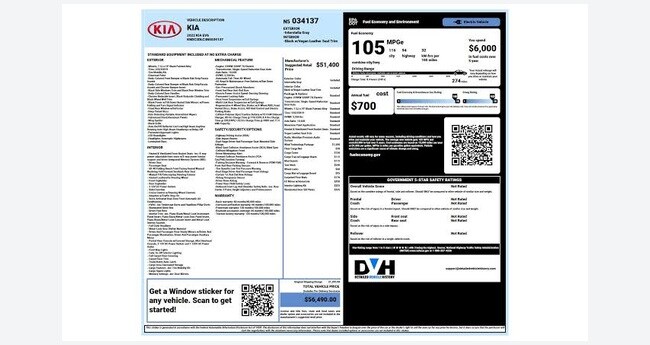
A Kia window sticker, or Monroney label, is read by reviewing four main quadrants: vehicle identification and drive configuration at the top, standard features and engine specs on the left, standard base MSRP versus factory-installed optional equipment prices on the right, and EPA fuel economy estimates alongside safety ratings at the bottom.
Every new Kia arriving on our lot carries this official sticker, mandated by federal law under the Automobile Information Disclosure Act. Designed to provide transparent, uniform information, the label ensures buyers evaluate vehicles using standardized pricing and factory specs. Understanding how to scan the layout efficiently helps shoppers isolate standard equipment from added options, verify mechanical configurations, and understand exactly what contributes to the vehicle's bottom line.
The top header of the sticker identifies the model year, model name, specific trim, trim code, interior and exterior paint colors, and manufacturing plant. Directly beneath the header, the sticker divides into distinct informational columns. The left column outlines standard features included in the base price, grouping items by categories such as mechanical specs, safety tech, interior comfort, and exterior styling. The right column handles financial accounting, starting with the base MSRP and itemizing factory-installed packages and individual options line by line before adding freight fees.
For drivers navigating daily commutes along Interstate 271 around Bedford, knowing how to interpret this document simplifies vehicle comparisons. If you want to check local model availability or speak with a vehicle advisor, feel free to give our sales team (440) 659-2032 for quick guidance. You can also explore our vehicle buying guides to learn more about trim levels, or drop by our Rockside Road showroom to inspect original window stickers in person.
Where Are Base MSRP, Destination Charges, and Total MSRP Listed on a Kia Window Sticker?
Base MSRP is listed at the top of the right-hand pricing column on a Kia window sticker, factory-installed options and packages are itemized below it, and the mandatory destination charge appears just above the final Total MSRP line at the bottom right.
The sticker clearly separates initial vehicle pricing from additional factory equipment and delivery expenses:
- Base MSRP: Represents the manufacturer's suggested retail price for the selected trim level in its standard configuration, before adding optional equipment, paint upgrades, or freight fees.
- Factory-Installed Options & Packages: Lists optional features added at the assembly plant, such as premium audio systems, panoramic sunroofs, or specialized styling packages, with their respective costs printed to the right.
- Destination and Handling Charge: A mandatory freight fee covering the cost of transporting the vehicle from the assembly plant to the dealership, typically ranging from $1,175 to $1,375 depending on model size.
- Total MSRP: The final sum of the Base MSRP, all factory-installed options, and the destination charge, establishing the official sticker price before dealer options, taxes, or registration.
To see how pricing scales across trim tiers, consider the 2026 Kia Sportage lineup. The 1.6 LX Hybrid AT trim carries a starting base MSRP of 30,490,whilethemid-tier1.6SHybridATstartsat32,790. Upgrading to the 1.6 EX Hybrid AT AWD brings the base price to 33,790.Whenfactorypackagesorcoloroptionsareselected,thoseitemizedcostsstackabovethebaseprice,increasingthefinalTotalMSRPaccordingly.
Similarly,multi-rowmodelsdisplaydistinctbasepricingsteps.The2026KiaCarnivalLXtrimbeginsatabaseMSRPof37,390, while the EX trim starts at 41,590,andtheEXHEVhybridvariantstartsat43,590. Checking these itemized figures on the right column ensures you know precisely what standard equipment you receive versus what factory add-ons add to the final total. If you are comparing new model pricing against pre-owned options, take a look at our current pre-owned vehicle inventory to evaluate how feature packaging impacts overall value.
Where Are Trim Package Names and Drive Type Located on a Kia Monroney Label?
The main trim package designation appears in the primary header block at the top of the sticker, while optional add-on package names are listed in the right-hand pricing section, and drive type is clearly specified in the vehicle description summary near the top left.
Identifying the exact trim level and drive configuration prevents confusion when comparing vehicles that look similar on the outside. In the top header block, Kia prints the specific trim designation alongside the model name—for example, indicating whether a vehicle is an EX, SX, or SX Prestige trim. Below the header, the vehicle summary line explicitly states the drivetrain configuration, distinguishing Front-Wheel Drive (FWD) models from those equipped with Dynamax All-Wheel Drive.
Option packages built into the vehicle at the factory are listed under the optional equipment section in the right column. These package titles, such as a GT-Line Package or X-Pro Prestige Package, combine specific comfort, appearance, or technology upgrades into single grouped items. Each package name is printed alongside its total price, allowing buyers to see exactly how much an option bundle adds to the vehicle's bottom line.
Our sales team frequently notices buyers reviewing the sticker header to confirm whether a model includes Dynamax All-Wheel Drive before taking a winter test drive. For drivers facing wet or icy winter roads in Cleveland, verifying all-wheel drive capability on the sticker provides confidence before ever starting the engine. If you want to experience how different trim packages feel on the road, consider scheduling a test drive with our team, or explore our certified pre-owned lineup to compare feature packages across model years.
How Do You Identify Engine Specs, Fuel Economy, and Driver Assist Tech Like Highway Driving Assist 1 vs 2?
Engine specifications and driver-assist technologies are detailed in the standard equipment text block on the left side of the sticker, while EPA fuel economy estimates and annual fuel cost projections occupy the large standardized graphic box in the lower-left corner.
The standard equipment column lists core mechanical components, detailing engine displacement, valvetrain design, horsepower ratings, and transmission type—such as an automatic 8-speed transmission or a dual-clutch Sportmatic® transmission. For example, the 2026 Kia Carnival specs highlight a 3.5L V6 engine generating 287 hp and 260 lb-ft of torque, delivering a maximum towing capacity of 3,500 lbs and an EPA rating of 18 mpg city / 25 mpg highway (21 mpg combined). Meanwhile, a model like the 2026 Kia Sportage Hybrid features a 1.6L turbocharged engine paired with an electric motor producing 232 hp and 271 lb-ft of torque, delivering EPA ratings of 35 mpg city / 36 mpg highway.
Advanced safety features and driver-assist systems are also cataloged in the safety equipment section of the left column. This is where buyers can distinguish between different generations of Kia's semi-autonomous driving systems:
- Highway Driving Assist 1: Combines adaptive cruise control with lane-centering assistance to maintain speed, following distance, and lane positioning on designated highways.
- Highway Driving Assist 2: Upgrades system capability by adding automatic lane-change assistance when the turn signal is activated, alongside machine-learning algorithms that adjust vehicle distance control based on learned driving habits.
Other active safety systems, such as Forward Collision-Avoidance Assist, Blind-Spot Collision-Avoidance Assist, and Rear Cross-Traffic Collision-Avoidance Assist, are itemized in the same safety column. Reviewing this section helps buyers confirm which driver-assist features are built into the vehicle from the factory. If you plan to trade in your current car to upgrade to a tech-equipped Kia model, you can start by valuing your trade-in online for a fast estimate.
What Is the Difference Between Factory-Installed Options and Dealer-Installed Add-Ons?
Factory-installed options are assembled directly at the manufacturing plant and printed on the main Monroney window sticker, whereas dealer-installed options are added after vehicle arrival and listed on a separate supplemental addendum sticker placed next to the factory label.
Distinguishing between factory equipment and dealer add-ons is essential for understanding standard vehicle pricing versus total purchase costs. Factory-installed items include major mechanical upgrades, interior leather upholstery, specialized paint colors, integrated tow hitches, and factory package bundles. Because these features are installed during vehicle production, their costs are fully integrated into the official Total MSRP on the primary window sticker and carry coverage under Kia's standard 10-year/100,000-mile powertrain warranty and 5-year/60,000-mile basic warranty.
Dealer-installed add-ons, by contrast, are accessories attached after the vehicle arrives at the dealership. Common dealer add-ons include all-weather floor liners, cargo trays, mudguards, wheel locks, roof rack crossbars, or protective film packages. These items do not appear on the official Monroney sticker because they are not installed at the factory. Instead, dealerships list them on a secondary label—often called an addendum sticker—placed adjacent to the Monroney glass. The addendum itemizes each accessory price and adds that total to the vehicle's retail price, ensuring total transparency regarding every accessory equipped on the car.
How Can Buyers Calculate the True Out-the-Door Price From a Kia Window Sticker?
The true out-the-door price is calculated by taking the sticker's Total MSRP, adding state and local sales taxes, title and registration fees, and the dealer documentation fee, then subtracting trade-in credit and applicable vehicle incentives.
While the Monroney window sticker provides an exact figure for Total MSRP, that number does not reflect final out-of-pocket settlement costs because federal law prohibits variable state taxes and licensing fees from being printed on the factory label. To determine your final out-the-door financial requirement, follow this step-by-step math structure:
- Agreed Vehicle Purchase Price: Start with the Total MSRP shown on the Monroney sticker, then consult the dealership for current pricing information.
- Dealer-Installed Add-Ons: Add the total cost of any dealer-installed accessories selected from the supplemental addendum sticker.
- State and Local Sales Tax: Calculate applicable sales tax based on your local county or municipal tax rate applied to the taxable vehicle purchase price.
- Title, License, and Registration Fees: Add official state vehicle transfer charges, license plate fees, and title registration costs.
- Dealer Documentation Fee: Include the standard administrative documentation fee associated with processing purchase paperwork.
- Trade-In Equity and Cash Down: Subtract your net trade-in allowance and initial cash down payment to arrive at your final balance to finance or pay at delivery.
By breaking down each component, buyers can evaluate financial terms clearly before finalizing their purchase contract. To explore current vehicle availability or begin your purchase calculations, browse our selection of new Kia vehicles, or utilize our online auto financing tools to get pre-qualified from home.
Frequently Asked Questions About Kia Window Stickers and Purchase Costs
Q: Is the destination charge included in the base MSRP on a Kia window sticker?
Base MSRP covers only the standard vehicle configuration and does not include freight costs. Kia lists the destination and handling charge separately near the bottom of the right-hand pricing column, adding it to the base MSRP and option totals to calculate the vehicle's final Total MSRP.
Q: Does the window sticker show state sales tax and registration fees?
The factory Monroney window sticker does not include state sales taxes, local county taxes, title transfer fees, or license plate registration costs. Because tax rates and licensing charges vary depending on where the vehicle is registered, these government fees are itemized separately on your final purchase agreement.
Q: Can option packages listed on the window sticker be separated or removed individually?
Factory-installed option packages printed on the Monroney label are built into the vehicle during manufacturing and cannot be unbundled or removed at the dealership. If a buyer prefers a model without specific factory packages, our sales team can locate or order a vehicle built to those exact preferences.
Q: How does a buyer confirm if a vehicle has all-wheel drive directly from the sticker?
Drive configuration is printed in the vehicle description section near the top header of the sticker. Look for explicit text indicating Front-Wheel Drive (FWD) or Dynamax All-Wheel Drive to confirm whether the vehicle includes all-wheel drive capability.
Q: What should buyers look for on a supplemental dealer addendum sticker?
A dealer addendum sticker is a secondary label placed next to the factory window sticker that itemizes accessories added after arrival, such as all-weather floor liners, mudguards, or cargo management accessories. Reviewing this sticker allows buyers to see individual accessory prices added to the factory vehicle total.
If you have additional questions about reading sticker labels or want to review pricing on a specific model, stop by our Bedford dealership location, call our team directly at (440) 659-2032, or learn about our team online to see how we assist vehicle buyers.
Master Your Kia Window Sticker and Drive Home With Confidence
Understanding every section of a Kia Monroney window sticker gives you total clarity during your vehicle shopping journey. By knowing where to locate base MSRP, how to evaluate factory packages versus dealer add-ons, and how to identify essential safety features like Forward Collision-Avoidance Assist, you can compare models on our lot with complete peace of mind.
Our team at Kia of Bedford is committed to providing a transparent, straightforward sales environment. Whether you are evaluating compact crossovers, spacious family SUVs, or high-efficiency hybrid models, our vehicle specialists are here to walk you through every line item on the sticker so you feel confident in your purchase decision.
Ready to take the next step toward your new Kia? Visit our showroom on Rockside Road today to inspect window stickers in person, test-drive your favorite models, and let our finance department tailor a purchase plan suited to your budget.
Prices and MSRP referenced in this article are estimates for informational purposes only and do not constitute an offer to sell. See dealer for complete details. Fuel economy estimates shown may differ from official EPA ratings and should not be relied upon as a guarantee of actual vehicle performance.
Categories:
News